
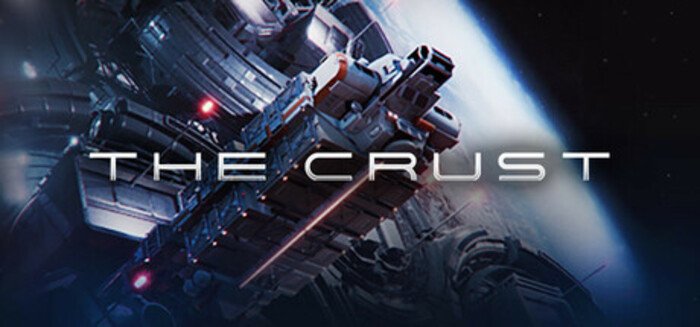
The Crust is a space-based strategy and colony management game that puts you in charge of humanity’s first serious attempt to build a permanent industrial presence on the Moon. Instead of simply constructing a small base and watching it grow, you have to manage an entire lunar operation, from mining raw materials to automating factories, looking after colonists, researching technology, and dealing with political decisions back on Earth.
What makes the game interesting is the way its different systems connect. A mining operation affects your factories, factories affect production, production affects trade, and the people working inside your colony have their own needs and abilities. You are essentially building a small industrial society on the Moon while trying to keep the operation profitable and alive.
What Is The Crust?
The Crust is a simulation and strategy game focused on lunar colonization, automation, resource management, exploration, and decision-making. The main objective is to establish a functioning colony on the Moon and gradually turn it into a powerful industrial operation.
At the beginning, your settlement is relatively limited. You need to extract resources from the lunar surface, process them, construct machinery, generate power, and establish production chains. As your technology improves, the colony becomes more complicated, but also more efficient.
Building a Lunar Colony
You begin by establishing the infrastructure necessary for survival and production. Buildings, machines, power systems, transportation networks, and processing facilities all need to work together. The further you progress, the more important it becomes to organize your colony properly.
Space is also part of the challenge. A poorly planned base can create unnecessary transportation problems and inefficient production chains. Building everything wherever there is empty space may work early on, but larger operations benefit from careful planning.
The finished game also introduces Planning Mode, which gives players another tool for organizing their construction before committing to changes. This is particularly useful when your colony has become large and complicated.
Mining and Resource Automation
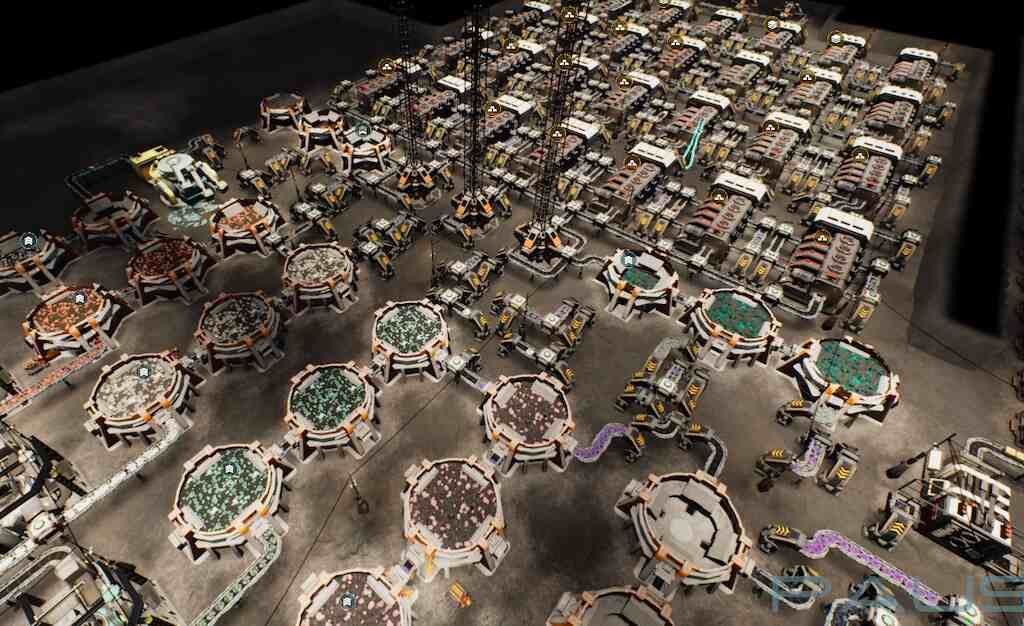
The Moon provides the raw materials needed to develop your colony, but extracting resources is only the first step. Those materials need to be transported, processed, and converted into useful products.
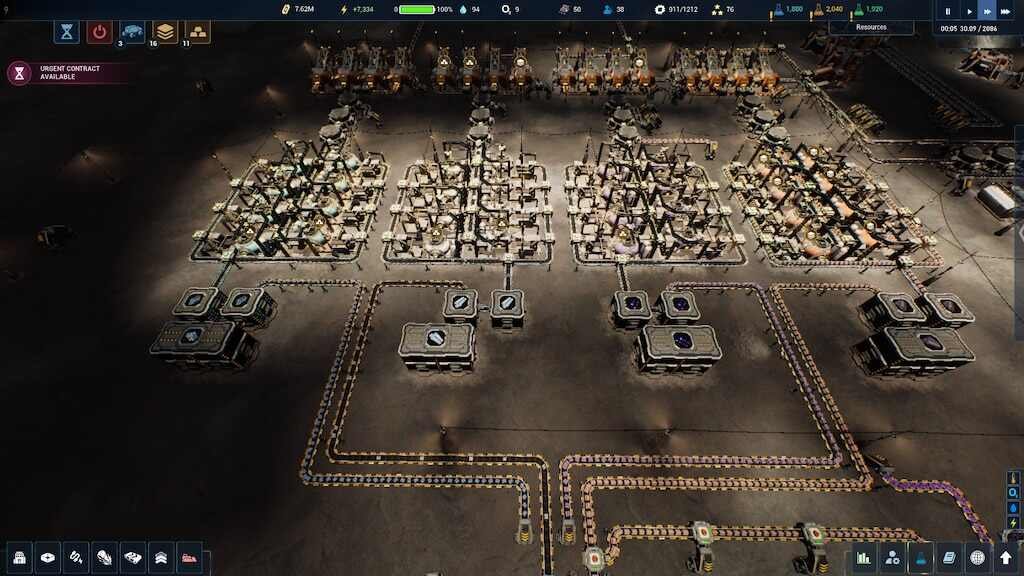
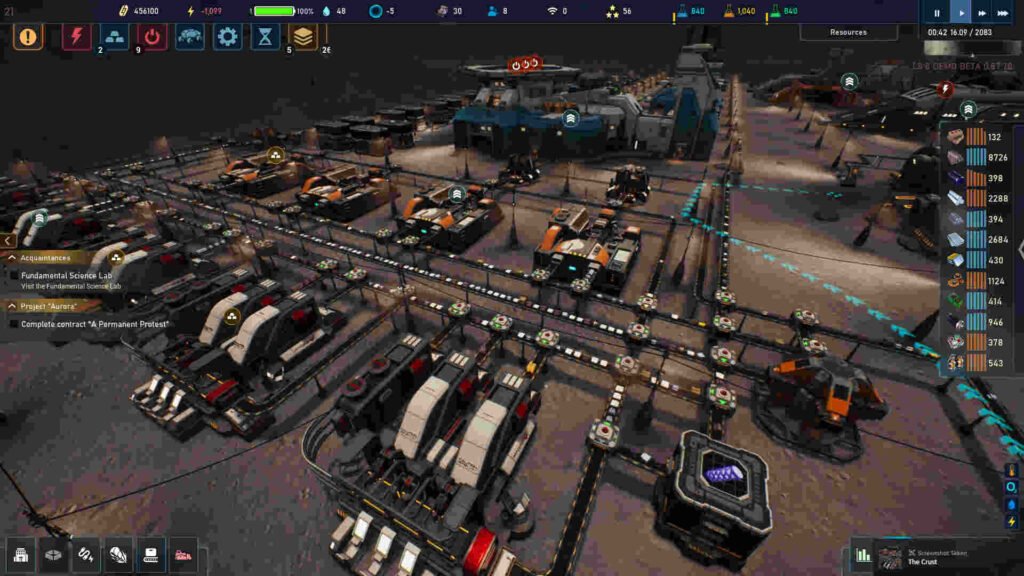
This is where automation becomes extremely important. The Crust allows players to create production systems using conveyor belts and drones. Instead of manually managing every resource movement, you can build networks that transport materials between different parts of the colony.
A well-designed automated factory can save enormous amounts of time and make your entire operation more efficient. At the same time, expanding too quickly can create new problems if your power supply or production capacity cannot keep up with demand.
Managing Colonists
Colonists have individual traits and skills, and you need to pay attention to their health, mood, and personal needs. Hiring the right people can make a noticeable difference because skilled workers can improve production and research efficiency.
This adds another layer to the usual city-building formula. You aren’t simply placing buildings and watching numbers increase. Your workforce has to remain healthy and productive.
As the colony grows, deciding who should work where becomes increasingly important. The right combination of specialists can help your research progress faster or improve the efficiency of your industrial systems. Gunman Contracts – Stand Alone
Research and Technology
The Crust includes three research trees that allow players to unlock scientific and technological improvements. These advancements can improve your infrastructure, production systems, and overall ability to survive and expand on the Moon.
Research creates a natural sense of progression. Early in the game, you’re concerned with basic survival and resource collection. Later, you have access to more advanced technologies that allow you to automate larger parts of the colony.
Choosing which technologies to prioritize can therefore influence the way your settlement develops. A player focused heavily on industrial production may make different research choices from someone more interested in exploration or colony development.
Exploring the Moon
Players can send a rover on lunar expeditions to investigate different locations and uncover resources and secrets. Exploration helps expand your understanding of the Moon and gives the colony access to opportunities beyond its immediate surroundings.
Exploration also contributes to the game’s narrative. The Moon isn’t simply an empty map covered with resource nodes. There are mysteries surrounding humanity’s lunar presence, and discovering them is part of the larger campaign.
This gives players a reason to step away from factory management and investigate what exists beyond the main colony.
Trading With Earth
Although most of your physical operation is on the Moon, Earth remains extremely important.
The Crust allows players to trade resources with Earth through contracts. These transactions aren’t only about making money. Your decisions can influence the political landscape and determine which Earth faction you support.
This creates an interesting connection between economics and politics. You may have a valuable resource that several factions want, forcing you to decide how to use the opportunity.
Supporting one faction can also create different consequences from supporting another. As a result, economic decisions become part of the wider strategy rather than simply being another way to increase your income.
Story and Multiple Endings
The 1.0 release includes the complete story campaign with multiple endings. This gives the game a stronger narrative structure than a traditional sandbox colony simulator.
The story follows humanity’s growing presence on the Moon and the complicated relationships between the lunar colony and Earth. Your economic decisions, political choices, exploration, and management decisions all take place within this larger science-fiction setting.
Having multiple endings also gives the campaign replay value. Players can make different decisions on another playthrough and see how the consequences affect the conclusion.
For players who prefer open-ended sandbox gameplay, the game also includes Sandbox 2.0, allowing you to focus more heavily on building and managing your own lunar operation rather than following the campaign.
Game Experience
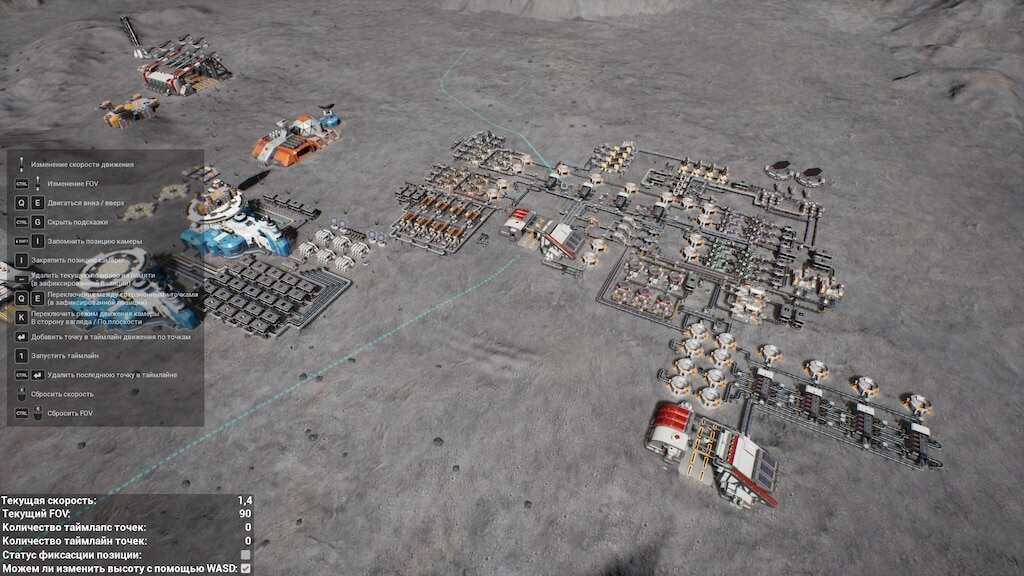
You might start by building a simple mining operation, only to discover that your factories need more power. Increasing power production then creates a demand for additional resources, which means expanding mining. Once production grows, your transportation network may become inefficient, forcing you to redesign parts of the colony.
This constant chain of problems is what makes the game engaging. There isn’t one single objective that you complete and then stop. Instead, every improvement creates new possibilities as well as new responsibilities.
The best moments often come when a complicated system finally starts working smoothly. Watching resources move through a network of conveyors and drones while your colonists keep production running gives the colony a feeling of being genuinely alive.
Graphics and Atmosphere
The Moon provides a naturally distinctive setting, with barren terrain surrounding the machinery and structures of your growing settlement. Industrial buildings, transportation systems, mining equipment, and lunar exploration vehicles give the colony a strong science-fiction identity.
The atmosphere is also different from traditional city builders. There are no crowded streets or green landscapes. Instead, you are building a technological outpost in an extremely hostile environment where every piece of infrastructure exists for a reason.
That contrast between the empty lunar landscape and a rapidly expanding human settlement is one of the game’s most appealing visual elements.
Multiplayer Information
The Steam listing identifies the game as a single-player strategy and simulation experience rather than an online multiplayer title.
This means the entire colony is under your control. You don’t have to coordinate with another player or compete for resources, allowing you to take your time and experiment with different approaches.
Players who prefer cooperative city builders may miss a multiplayer option, but the single-player design works well with the game’s detailed management systems.
Latest Update and Full Release
The 1.0 version includes the complete campaign, multiple endings, Planning Mode, Sandbox 2.0, global events, and macOS support. This makes the current version substantially more complete than the original Early Access release.
The game has also maintained a generally positive reception on Steam. At the time of writing, the store page shows mostly positive overall English-language reviews and positive recent reviews, although individual player experiences can naturally vary.
Performance on PC
The official minimum specification requires a 64-bit operating system, an Intel i5-4590K or equivalent AMD processor, 8 GB RAM, a GeForce GTX 1060-class graphics card with 6 GB VRAM, DirectX 11, and 8 GB of available storage.
The recommended specification moves up to an Intel i5-7700 or equivalent AMD processor, 16 GB RAM, and a GeForce GTX 1070-class GPU with 8 GB VRAM. DirectX 12 is recommended for this configuration.
The game is also available on macOS and SteamOS/Linux, although the exact requirements differ between operating systems.
Pros and Cons
Pros
- Interesting lunar-colony setting
- Deep automation systems
- Detailed resource management
- Colonist traits and needs
- Lunar exploration
- Earth trading and political decisions
- Full story campaign
- Multiple endings
- Sandbox 2.0
- Planning Mode
- Single-player design
Cons
- Can become complicated for new players
- Large production chains require careful planning
- No multiplayer mode
- Some systems may feel overwhelming at first
- Players looking for fast-paced gameplay may find the pace slow
Is The Crust Worth Playing?
The Crust is a strong choice for players who enjoy strategy games where growth comes from careful planning rather than quick reactions.
Its biggest strength is the combination of systems. Mining, automation, research, colonist management, exploration, trade, and politics aren’t completely separate mechanics. They influence each other, creating a colony that feels like a connected machine.
The move to version 1.0 also makes this a particularly interesting time to try the game. Instead of entering an unfinished Early Access project, new players can now experience the completed campaign, multiple endings, Planning Mode, Sandbox 2.0, and other additions introduced for the full release.
Final Verdict
The Crust offers a thoughtful combination of lunar exploration, colony management, automation, strategy, and science-fiction storytelling. Its Moon setting immediately gives it a different personality from traditional city-building games, while the interconnected management systems provide plenty of depth.
The automation mechanics are particularly satisfying because a successful factory can transform the way your entire colony operates. At the same time, colonist management, Earth politics, resource trading, and exploration prevent the experience from becoming nothing more than a factory-building simulator.
With the full 1.0 release now available, The Crust has reached a much more complete state than its original Early Access version. The finished campaign and multiple endings also give players a reason to explore the game’s story, while Sandbox 2.0 provides freedom for those who simply want to build.